> For the complete documentation index, see [llms.txt](https://docs.warpstream.com/warpstream/llms.txt). Markdown versions of documentation pages are available by appending `.md` to page URLs; this page is available as [Markdown](https://docs.warpstream.com/warpstream/kafka/configure-kafka-client/administrate-your-byoc-clusters-with-serverless.md).
# Hosted Metadata Endpoint
This page explains how you can leverage WarpStream's hosted metadata endpoint to administer your WarpStream BYOC clusters from anywhere.
You can use WarpStream's hosted `serverless.warpstream.com:9092` endpoint to easily run any Kafka administrative tasks for your BYOC clusters, like creating topics. The hosted endpoint can handle almost all Kafka protocol requests except for Produce and Fetch because WarpStream does not have **any** access to your data with our BYOC product.
### **Instructions**
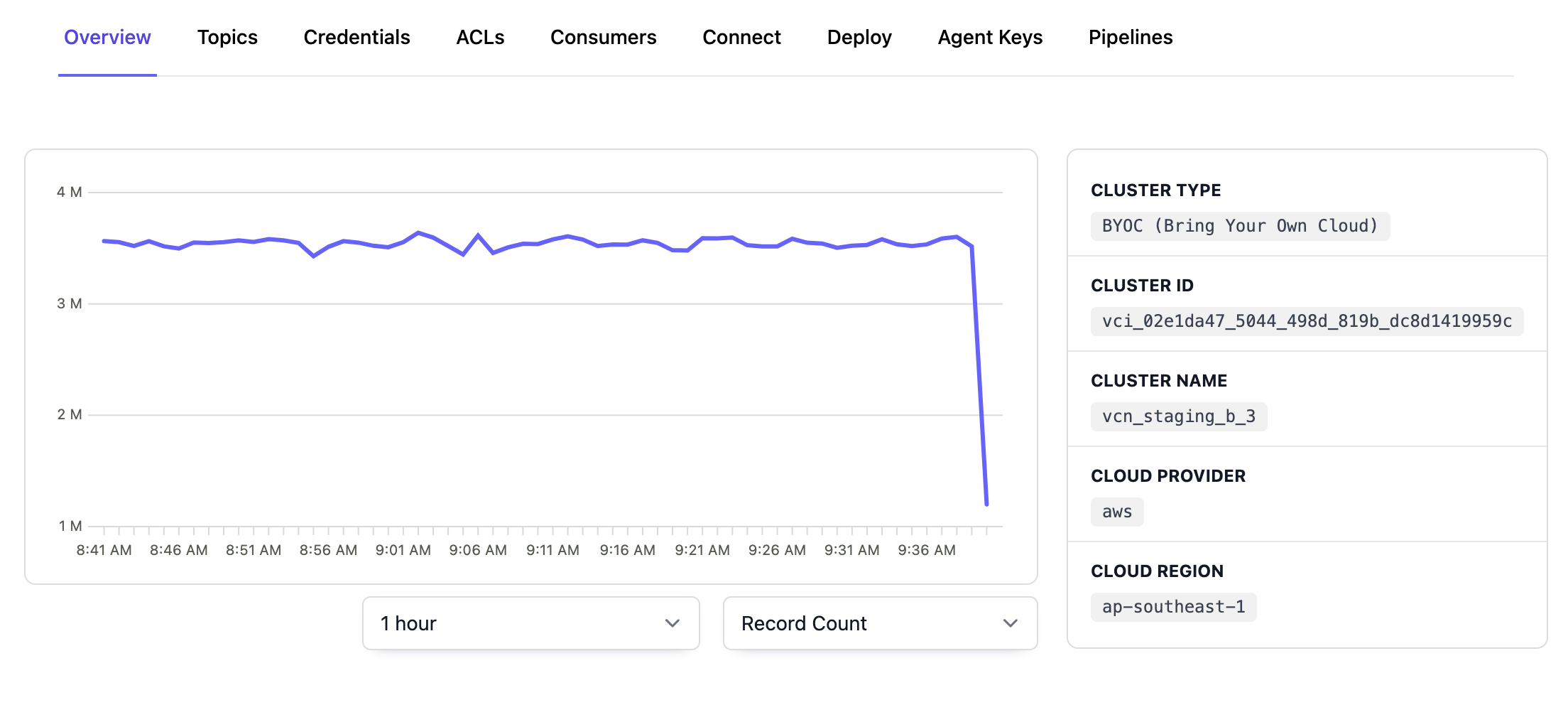
First, identify your cluster's region and ID from the "Overview" tab (e.g., `ap-southeast-1` and `vci_xxx`).
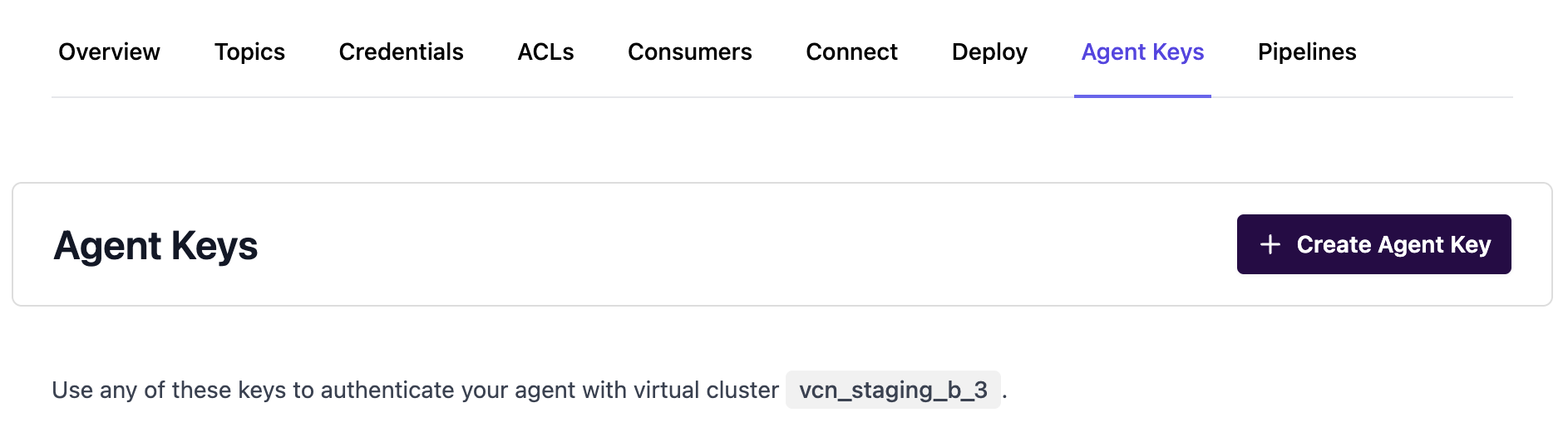
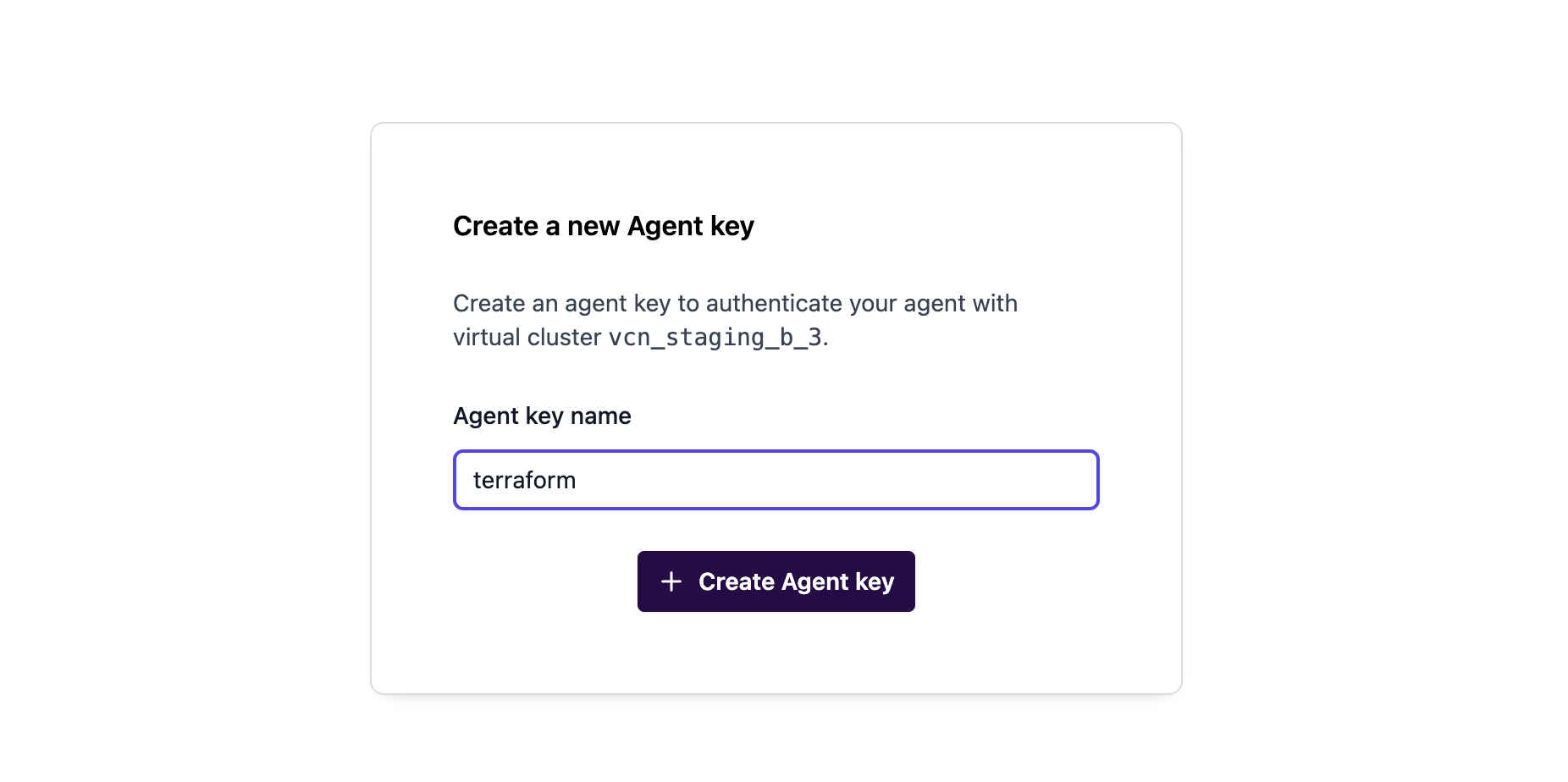
Next, create a new dedicated agent key in the "Agent Keys" tab (e.g., `aks_xxx`).
Finally, arrange the credentials in this format and configure your Kafka client to connect with TLS enabled using SASL PLAIN:
```xml
SASL_USERNAME=::
SASL_PASSWORD=
```
Concretely that would look like:
```
SASL_USERNAME=ap-southeast-1::vci_02e1aa27_5024_695d_819b_dc2d1719959d
SASL_PASSWORD=aks_29c445a02ae375e31c316eab7c69e2f1709b16bdcc044ab3a2489da19ae9239b
```
#### **Example: franz-go**
```go
var (
virtualCluster = "vci_xxx"
agentKey = "aks_xxx"
region = "xxx" // e.g. "us-east-1"
)
opts := []kgo.Opt{
kgo.SeedBrokers("serverless.warpstream.com:9092"),
kgo.DialTLS(),
kgo.SASL(plain.Auth{
User: fmt.Sprintf("%s::%s", region, virtualCluster),
Pass: agentKey,
}.AsMechanism()),
}
adm, err := kadm.NewOptClient(opts...)
```
#### Example: terraform
[See our terraform example on Github.](https://github.com/warpstreamlabs/terraform-provider-warpstream/blob/main/examples/byoc-with-topics/main.tf)
---
# Agent Instructions
This documentation is published with GitBook. GitBook is the documentation platform designed so that both humans and AI agents can read, navigate, and reason over technical content effectively. Learn more at gitbook.com.
## Querying This Documentation
If you need additional information that is not directly available in this page, you can query the documentation by asking a question.
Perform an HTTP GET request on the following URL with the `ask` and `goal` query parameters:
```
GET https://docs.warpstream.com/warpstream/kafka/configure-kafka-client/administrate-your-byoc-clusters-with-serverless.md?ask=&goal=
```
`ask` is the immediate question: it should be specific, self-contained, and written in natural language.
`goal` is what the user is ultimately trying to achieve, the reason they need the answer. Sharing it helps GitBook give you a better, more relevant answer. A goal is most helpful when it describes the outcome the user wants rather than restating the question. For example, with `ask=how do I create an API token`, a goal like `automate deployments from our CI pipeline` lets GitBook tailor the answer to that use case.
The response will contain a direct answer to the question and relevant excerpts and sources from the documentation.
Use this mechanism when the answer is not explicitly present in the current page, you need clarification or additional context, or you want to retrieve related documentation sections.